At some point, looking after ourselves appears to have acquired an entirely new vocabulary.
We no longer simply want to feel better. We’re optimising, biohacking, supporting cellular health and exploring longevity. We’re tracking our sleep, monitoring our recovery and discovering therapies with names that sound as though they belong in a university laboratory.
And while there’s some genuinely interesting science behind much of this language, we can appreciate why the wellness world sometimes feels a little difficult to navigate.
What exactly are we optimising? Is longevity simply another word for ageing? And why does something as straightforward sounding as red light therapy have a scientific name that most of us struggle to pronounce?
At HybO2 House, we love the science of what we do. But we also believe that understanding your wellbeing shouldn’t require a medical dictionary.
So, let’s make sense of a few of the words you might have come across.

Biohacking: Taking a little more interest in how your body works
Biohacking is one of those terms that can mean very different things depending on who you’re talking to.
For some, it’s about monitoring sleep, adjusting nutrition or using wearable technology to understand how their body responds to exercise and stress.
For others, it’s about exploring emerging wellness technologies and taking a more proactive approach to their health.
The common thread is curiosity.
Rather than simply accepting how we feel from day to day, biohacking is about understanding the factors that influence our wellbeing and making intentional changes.
It’s also one of the areas where therapies such as hyperbaric oxygen therapy (HBOT) and red light therapy have attracted interest from people exploring different approaches to performance and recovery.
And no, you don’t need to own six wearable devices or have a spreadsheet documenting every minute of your sleep to be interested in biohacking.
Although we suspect some of our followers may have both 😉
Longevity: It’s not just about living longer
Longevity has become an enormous subject within the wellness industry. But the conversation has moved beyond simply adding more years to our lives.
Increasingly, people are interested in healthspan: the years we are spending living in good health, remaining active and maintaining our independence.
It’s the difference between wanting to reach a particular age and wanting to continue enjoying the things that matter to us when we get there.
Travelling. Exercising. Spending time with family. Getting up in the morning and feeling capable of whatever the day brings.
Of course, no single therapy can promise us a longer or healthier life.
But the growing interest in longevity has encouraged researchers to look more closely at what happens to our bodies as we age, including changes in cellular function, inflammation and our ability to adapt and recover.
Which brings us rather neatly to another phrase you’ll hear regularly at HybO2 House.
Cellular Health: What’s happening beneath the surface?
We spend a lot of time thinking about how our bodies look and feel, but considerably less time thinking about what’s happening inside them.
Our cells are constantly working to keep us functioning. They’re involved in everything from producing energy and communicating with one another to responding to the demands we place on our bodies.
And much of the research surrounding modern wellness therapies is interested in understanding these processes.
Red light therapy is a particularly interesting example.
Its scientific name is, photobiomodulation, which sounds considerably more complicated than lying in a bed surrounded by red light.
But there’s a little more happening than the colour might suggest.
Photobiomodulation uses specific wavelengths of red and near-infrared light that can interact with processes within our cells, including those involving the mitochondria, the tiny structures responsible for helping produce cellular energy.
This relationship has led researchers to explore photobiomodulation across areas including skin health, muscle function and recovery.
At HybO2 House, our full-body, 360 contact red light therapy bed allows us to work with different wavelengths, frequencies and duty cycles, adjusting sessions according to individual goals and suitability.
It’s a good example of how the technology behind a therapy can be considerably more interesting than its name initially suggests.
Hyperbaric: What does the pressure actually do?
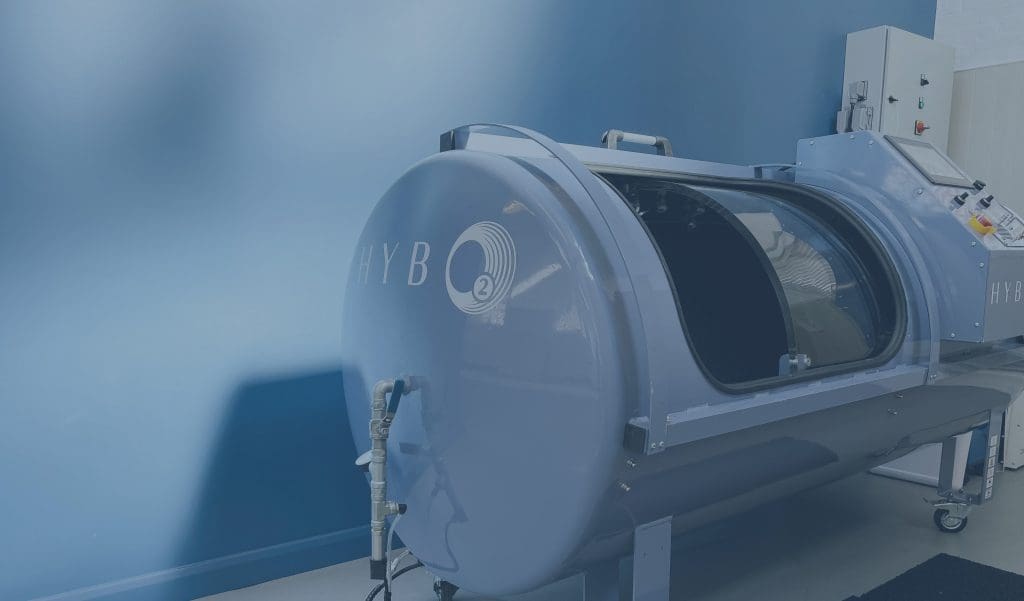
Hyperbaric is another word that sounds far more intimidating than it needs to.
Put simply, it describes an environment where pressure is higher than normal atmospheric pressure.
Hyperbaric oxygen therapy combines that increased pressure with breathing oxygen. At HybO2 House, our chambers operate at 2.0 ATA, meaning twice the atmospheric pressure experienced at sea level.
During a session, clients breathe near-pure oxygen through our Built-In-Breathing System or BIBS, while inside the pressurised chamber.
The combination of oxygen and increased pressure changes the way oxygen is delivered throughout the body, which is central to the science behind HBOT.
And it’s what distinguishes hyperbaric oxygen therapy from simply breathing oxygen at normal atmospheric pressure.
HBOT has established uses in certain medical settings, while research continues into a much wider range of potential applications. Different conditions, pressures and treatment protocols need to be considered individually rather than assuming that every use of HBOT is equally established.
For our clients, it’s another opportunity to explore a technology that has attracted interest across recovery, performance and wider wellbeing.
IV Therapy: More than an impressive-looking drip
And then there’s IV Therapy.
You might have seen it described as intravenous therapy, infusion therapy, nutrient therapy or simply a vitamin drip.
The terminology varies, but IV stands for intravenous, meaning something delivered directly into a vein.
IV therapy can be used to administer fluids and, depending on the formulation, specific vitamins or other nutrients.
It’s important to distinguish the established medical uses of intravenous treatment from the broader claims sometimes made about wellness drips. For most people, everyday hydration and nutritional needs can be met through food and drink, and additional nutrients aren’t automatically beneficial simply because they’re delivered intravenously.
At HybO2 House, The Drip Bar gives clients the opportunity to explore our available IV formulations with our nurse, Bernie, who can discuss their individual circumstances, goals and suitability.
Because understanding what you’re choosing matters just as much as understanding what it’s called.
Personalised protocols: Making the technology relevant to you
This is another phrase we use at HybO2 House, and it’s perhaps one of the most important to understand.
A protocol is simply a planned approach to how a therapy is delivered.
That might include the duration of a session, the settings used, the frequencies and duty cycles. Our HBOT offering includes different session durations and clients may explore combining therapies where appropriate.
Understanding what someone wants from their experience helps our team discuss the available options and how they might fit together.
The terminology might sound technical, but the idea behind it is straightforward; making informed choices about the experience you’re having.
Wellness shouldn’t require a dictionary
There’s nothing wrong with the wellness industry having its own language.
In fact, many of these terms exist because we’re developing a deeper understanding of the human body and exploring technologies that wold have seemed extraordinary not so long ago.
But the words themselves shouldn’t’ be the most important part of the experience.
You don’t need to know how to pronounce photobiomodulation to be curious about red light therapy.
You don’t need to be an expert in atmospheric pressure to explore HBOT (That’s our job)
And you certainly don’t need to describe yourself as a biohacker to take an interest in your health.
At HybO2 House, we’re interested in the research, the technology and the possibilities they continue to open up. Just as importantly as we want our clients to feel comfortable asking questions and understanding the therapies they’re considering.
Because the more you understand about your options, the more confidently you can decide what belongs in your own wellbeing routine.
Curious about HybO2 House?
If some of these wellness terms have caught your attention and you’d like to experience what we do for yourself, our Signature Experience is a fantastic introduction to HybO2 House.
For £85, it includes:
A full consultation with our team
10 minutes of red light therapy
45 minutes of hyperbaric oxygen therapy
A recommended pathway based on your goals
It’s an opportunity to experience both therapies, discover more about the technology and understand how they could fit into your wider approach to wellbeing.
And if IV therapy has caught your interest, our nurse Bernie can help you explore the options available at The Drip Bar.
If you’d like to book an appointment, or simply have some questions you’d like to ask us, reach out to us at HybO2 House, 01962 862 111 for more information.