There’s a point in midlife when you start wondering:
Why does everything suddenly feel different?
Your knees complain when you stand up. You feel stiffer first thing in the morning. A workout takes longer to recover from. Sleep isn’t quite as reliable as it used to be.
And then there’s the brain fog.
Walking into a room and forgetting why. Losing your train of thought halfway through a sentence. Searching for a word you absolutely know but apparently your brain has decided not to share with you today.
For many women in their 40’s and 50’s, these changes arrive around the same time another word becomes increasingly relevant:
Perimenopause.
And why hot flushes and changing periods get most of the attention, they are only part of the story.
This year, World Menopause Day on 18th October is focusing specifically on Chronic Pain at Midlife, an area the International Menopause Society say remains underestimated in research and care.
The aches aren’t in your imagination
A major global review looked at 321 studies involving 482,067 women and examined 19 different menopause related symptoms.
The most commonly reported symptom wasn’t hot flushes.
It was joint and muscular discomfort. Reported by 65.43% of women.
And newer research tells a similar story.
A 2026 review of more than 93,000 women across 22 countries found muscle or joint pain in around:
40% of premenopausal women
57% of perimenopausal women
59% of postmenopausal women
So if your body suddenly seems considerably more vocal than it used to be, you’re certainly not alone.
That doesn’t mean every new ache should automatically be blamed on hormones. Persistent or significant pain deserves investigating.
But neither should women simply be told:
“Well, you’re getting older.”
And then there's brain fog...
Menopause isn’t only physical.
The NHS recognises poor memory, difficulty concentrating, brain fog, low mood and anxiety among the symptoms women can experience during perimenopause and menopause.
Brain fog sounds fairly harmless until it starts happening to you.
Forgetting names. Losing your train of thought. Finding it harder to concentrate. Feeling mentally slower or less sharp than you’re used to.
Add disturbed sleep, lower energy and changes in mood, and midlife can start feeling very different indeed.
So the menopause conversation needs to be bigger than hot flushes.
It’s also about pain, movement, recovery, sleep, energy, mood and cognitive health.
And that’s where some of the research surrounding red light therapy and hyperbaric oxygen therapy becomes particularly interesting.
Red light therapy: far more than skincare
Red light therapy has become increasingly popular, but it’s still sometimes treated as though it’s predominantly a beauty treatment.
The research goes much further.
Specific wavelengths of red and near-infrared light interact with cells and tissues, and scientists are studying red light therapy across areas including pain, inflammation, cellular energy, recovery and physical function.
Take knee osteoarthritis.
A 2024 review brought together 10 placebo-controlled studies involving 542 people and found that red light therapy significantly reduced pain at rest compared with placebo.
Then a 2025 randomised trial reported improvements in pain, stiffness, everyday function and quality of life in its red light therapy group.
Neither study was specifically about menopause.
But when joint and muscular discomfort is so commonly reported during the menopause transition, research into pain and movement becomes particularly relevant.
What about red light and the brain?
This is where things become even more interesting
Researchers are also studying how red and near-infrared light may influence cognitive function and mental wellbeing.
A 2025 systematic review brought together 24 randomised trials involving 820 people and reported improvements in areas including overall cognition, working memory, attention and aspects of executive function.
A separate 2026 review of 18 trials investigating red light therapy in people with depression or clinically significant depressive symptoms also found an overall improvement in depressive symptoms.
Different studies use different ways of delivering the light. Some brain research uses light directed specifically towards the head.
At HybO2 House, our approach is different.
Our 360° full-body red light therapy bed surrounds the body from head to toe with red and near-infrared light, rather than treating one small, isolated area.
We can’t simply take the findings from one specialist research protocol and assume they’ll be identical with every red light system.
But the growing research into light, cellular energy, cognition and mood is particularly exciting to follow.
It’s another reason red light therapy has become a much bigger conversation than simply skin and beauty.
And then there's oxygen under pressure
Hyperbaric oxygen therapy (HBOT) approaches the body in a completely different way.
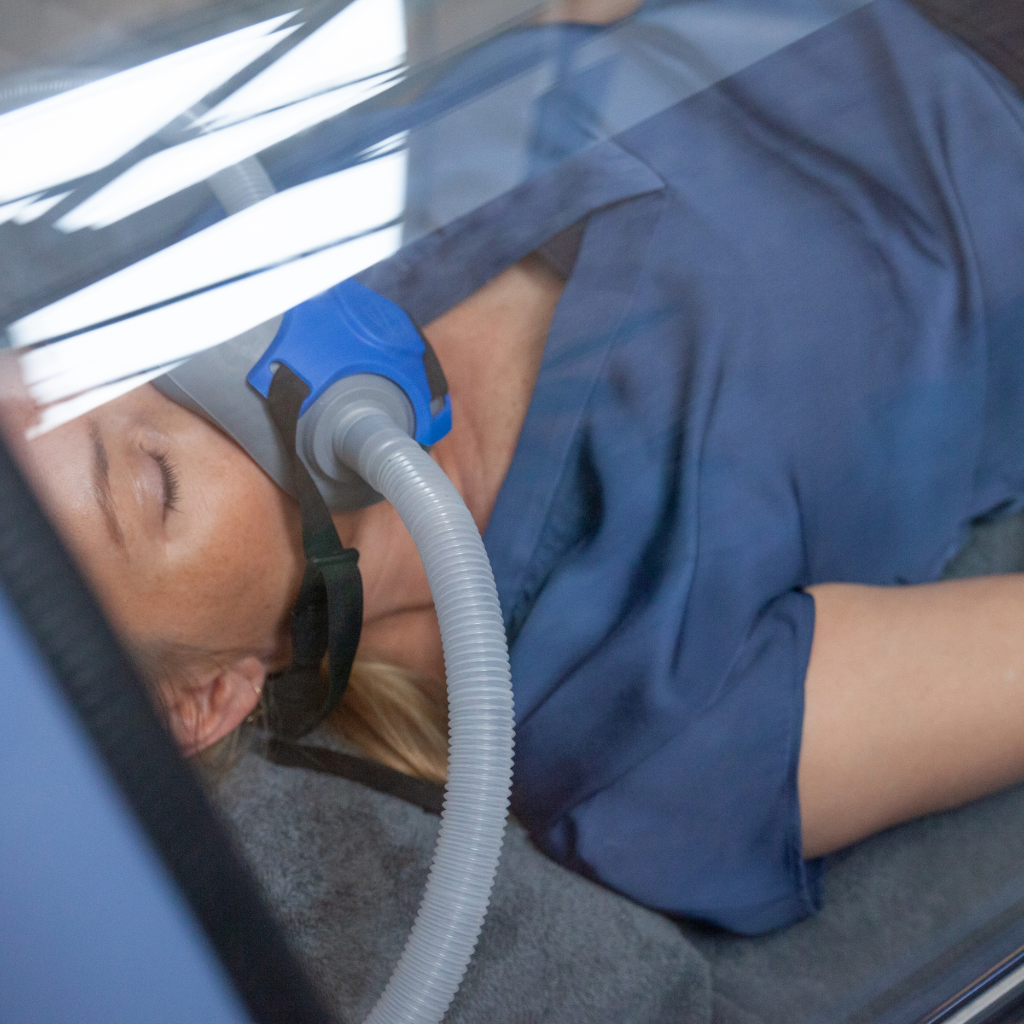
At HybO2 House, our hard-shell chambers operate at 2.0 ATA, twice normal atmospheric pressure, while you breathe near-pure oxygen through our BIBS system once at full pressure.
That combination creates a very different oxygen environment within the body.
Researchers continue to study HBOT across areas including tissue repair, inflammation, neurological function, pain and recovery.
And mental health is becoming part of that conversation too.
A 2026 review brought together 17 studies involving 920 adults, including nine randomised controlled trials, investigating HBOT in psychiatric conditions.
Overall, researchers reported promising results for depressive symptoms and anxiety. Interestingly, the strongest pooled effect on depressive symptoms was seen in studies using 2.0 ATA rather than lower pressure.
Again, this was not menopause-specific research.
But when midlife can bring changes in mood, mental sharpness, energy and physical recovery, it adds another interesting piece to the wider picture.
And the research keeps moving
Perhaps one of the most interesting things about this area is that the science is still developing.
Researchers are continually asking new questions about light, oxygen, ageing, metabolism, cognition, pain and women’s health.
There is even a registered clinical trial specifically investigating HBOT in postmenopausal women with insulin resistance.
The planned study involves 40 women and includes a course of 30 HBOT sessions. At present, no results have been posted, so there is nothing to conclude from it yet.
But the fact that research is beginning to look specifically at HBOT within postmenopausal health is interesting in itself.
Some studies will produce exciting findings. Others won’t.
That’s how science moves forward.
And it’s why we prefer to keep following the research rather than simply repeating the same wellness claims year after year.
This isn't another "menopause hack"
Menopause has become an enormous wellness market.
And women are now being sold everything from supplements to gadgets promising to fix an ever-growing list of symptoms.
We don’t need to add HBOT or red light Therapy to the miracle-cure pile.
The more interesting conversation is much more grounded.
Women at midlife commonly experience changes in pain, mood, cognition, sleep, energy and recovery.
At the same time, red light therapy and HBOT are both being actively researched in several of those areas.
Those conversations naturally overlap.
That doesn’t mean either therapy replaces speaking to your GP, discussing HRT where appropriate, moving your body, strength training, sleeping well or investigating symptoms that don’t feel right.
It means there may be more options worth exploring as part of the bigger picture.
Maybe the real conversation is about feeling like yourself
Midlife doesn’t always arrive with one dramatic symptom.
Sometimes it’s lots of small changes.
You ache more.
You recover a little more slowly.
Sleep becomes less reliable.
You lose your train of thought.
Your energy changes.
And yet you’re still trying to do everything you’ve always done.
Work. Family. Exercise. Social life. Life in general.
Perhaps that’s why being more deliberate about recovery and looking after yourself starts to matter.
Not because women in midlife need fixing.
But because there’s enormous value in continuing to feel strong, capable, clear-headed and like yourself.
Curious about HybO2 House?
At HybO2 House, our Signature Experience is £85 and gives you the opportunity to experience both technologies.
It includes:
A full consultation
10 minutes of 360° full-body Red Light Therapy
45 minutes of Hyperbaric Oxygen Therapy
And time afterwards to discuss what has brought you to us and what an appropriate next step might look like.
Because if your body suddenly feels a little less familiar than it used to, you don’t simply have to shrug and put it down to age.
Pay attention. Ask questions. Investigate what needs investigating — and stay curious about what might help you feel more like yourself.
If you’d like to book an appointment, or simply have some questions you’d like to ask us, reach out to us at HybO2 House, 01962 862 111 for more information.