We all know what it feels like to be tired.
A late night. A busy week. Too much work and not quite enough sleep. Usually, a decent rest and a quieter weekend can help us feel more like ourselves again.
But for someone living with Long COVID, ME/CFS or fibromyalgia, fatigue can mean something very different.
It can be waking up exhausted despite having slept. Struggling to concentrate on a conversation. Feeling physically drained by things that once felt completely ordinary. It can sit alongside pain, brain fog, disturbed sleep and a body that simply doesn’t seem to recover in the way it used to.
And for many people, it can be incredibly frustrating, particularly when their symptoms aren’t always visible to everyone else.
These are some of the conversations we increasingly have with people researching hyperbaric oxygen therapy (HBOT).
So why is HBOT being studied in these areas? And what is the research actually showing?
Why oxygen? And why pressure?
One of the easiest mistakes to make with HBOT is to think it’s simply about breathing more oxygen.
The pressure is a huge part of the story.
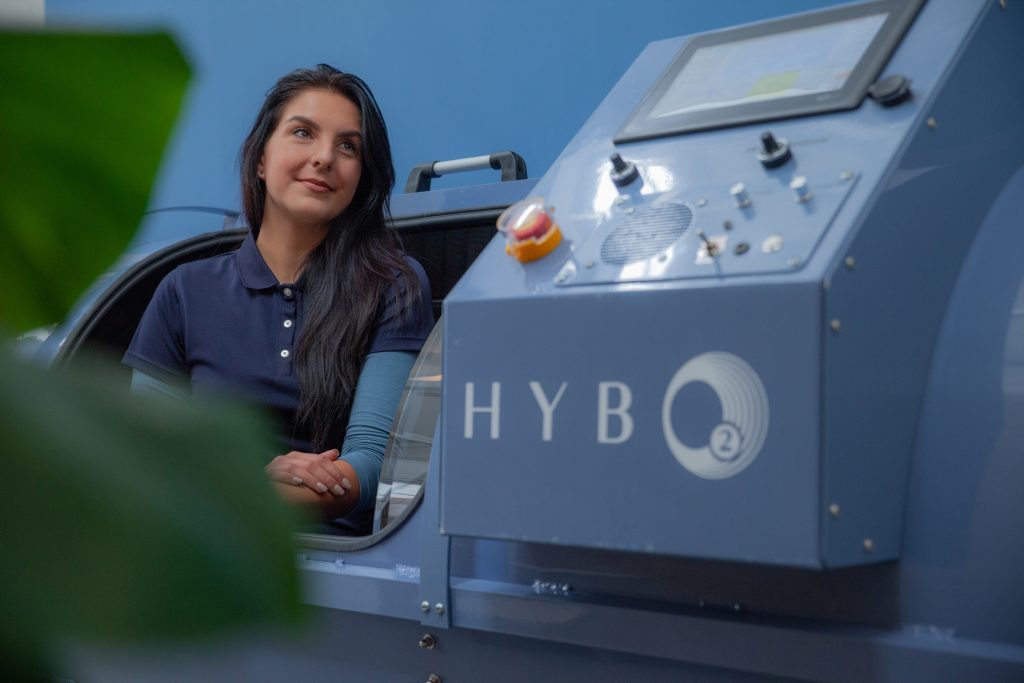
At HybO2 House, our chambers operate at 2.0 ATA, twice normal atmospheric pressure. Once at pressure, near-pure oxygen is delivered through a BIBS mask.
Together, the oxygen and increased pressure create a very different environment within the body than breathing oxygen normally.
This significantly increases the oxygen available to tissues and is one of the reasons HBOT has long been used and studied in areas connected with healing and recovery.
Researchers are now also looking at how repeated HBOT sessions may influence things such as inflammation, blood flow, the formation of new blood vessels, cellular function and processes within the brain.
And that has led to growing interest in conditions where fatigue, pain and cognitive symptoms can play such a major role.
Long COVID: Where some of the strongest research has emerged.
Long COVID can look very different from one person to another.
For some, fatigue is the overwhelming symptom. Others struggle with brain fog, concentration, sleep, pain or a dramatic reduction in the amount of physical activity they can manage.
An early UK study looked at 10 people experiencing Long COVID symptoms who completed 10 HBOT sessions.
Despite being a very small study, researchers recorded significant improvements in fatigue and several areas of cognitive function, including attention, information-processing speed and executive function.
It was an early piece of research, but an interesting one.
Then came a much larger and more robust study.
In 2022, researchers carried out a randomised, double-blind, sham-controlled trial involving 73 people with Long COVID symptoms lasting at least 3 months.
37 participants received over 40 HBOT sessions at 2.0 ATA, while 36 received sham treatment.
Following the course, the HBOT group showed significant improvements compared with the control group in areas including overall cognitive function, attention, executive function, energy, sleep and the extent to which pain interfered with everyday life.
That matters because this wasn’t simply a collection of people saying they felt better after HBOT. It was a controlled trial designed to compare HBOT with a sham treatment.
It’s one of the reasons Long COVID has become such an interesting area of HBOT research.
And now there’s new research into ME/CFS
ME/CFS – Myalgic Encephalomyelitis/Chronic Fatigue Syndrome – can involve profound fatigue, pain, problems with concentration and a worsening of symptoms after physical or mental activity.
For people living with it, “being tired” doesn’t begin to describe the experience.
And in June 2026, an interesting new HBOT study was published.
Researchers followed 30 people with ME/CFS through 40 HBOT sessions.
After treatment, they recorded improvements in areas including:
- Physical functioning
- Fatigue
- Pain
- Exercise capacity
- Muscle strength
- Speed of information processing
Perhaps one of the easiest statistics to understand is this:
23 of the 30 participants said they felt they had improved after completing the HBOT course.
Researchers also used brain imaging and recorded changes following treatment in areas of brain connectivity they were investigating in relation to ME/CFS.
This study didn’t include a sham-treatment comparison group, so there is still more for researchers to investigate.
But for a condition that can have such a significant impact on everyday life, these findings give researchers another strong reason to keep looking at HBOT.
What about fibromyalgia?
Fibromyalgia is another condition where the symptoms can stretch far beyond pain.
Fatigue, poor quality sleep, cognitive difficulties and widespread tenderness can all form part of the picture.
And HBOT hasn’t just been investigated in one isolated fibromyalgia study.
A 2023 review brought together 9 studies involving 288 people.
Overall, researchers found improvements in pain compared with control treatments, while a number of the individual studies also reported improvements in areas such as fatigue, sleep, tender points and everyday functioning.
When several different studies begin pointing towards similar areas of potential benefit, it becomes an increasingly interesting field to follow.
Why protocol matters.
One thing that becomes very clear when you look at HBOT research is that there isn’t one universal protocol for every person or every goal.
Different studies use different pressures, session lengths, frequencies and total numbers of sessions. And in the real world, people respond differently too.
That’s why we prefer to thing in terms of a course of therapy, followed by a review, rather than suggesting there is one magic number that applies to everyone.
At HybO2 House, many clients begin with a block of 10 sessions. From there, we look at how they’re responding, what they’re hoping to achieve and whether continuing with further sessions may be appropriate.
For some people, 10 sessions may feel like a meaningful starter point. For others, particularly where symptoms have been present for a long time or the goal is more complex, a longer course may be worth exploring.
HBOT is not about chasing a number. It’s about finding the right approach for the individual.
So, where does that leave us?
The research into HBOT for Long COVID, ME/CFS and fibromyalgia is still developing, but this is no longer a conversation based purely on anecdotes.
We now have:
73 people in a randomised Long COVID trial, with improvements reported in cognition, energy, sleep and pain.
30 people in a new 2026 ME/CFS study, where 23 said they felt improved following their course of HBOT.
And a review of 9 fibromyalgia studies involving 288 people, finding positive results particularly around pain, with several studies also reporting changes in fatigue, sleep and everyday function.
There are still questions to answer, and research will continue to evolve.
But there is also a growing body of evidence explaining why people living with persistent fatigue, pain and cognitive symptoms are becoming increasingly interested in HBOT.
And importantly, the conversation has moved far beyond simply saying that HBOT “gives you more oxygen.”
Scientists are looking at what happens when oxygen and pressure are combined, how the body responds over a course of sessions and what that could mean for different groups of people.
Exploring HBOT at HybO2 House
We regularly speak to people who have spent weeks, months, sometimes years, researching ways to support their health.
Often, they arrive already knowing quite a lot about HBOT.
Our role is to help make the next part simpler.
We can explain how HBOT works, what a session actually feels like, what the research says in the area they are interested in and what an appropriate approach may look like for them.
Because when fatigue becomes something much bigger than simply feeling tired, it’s understandable to want to know what options are being explored.
And increasingly, HBOT is becoming part of that conversation.
Curious about HybO2 House?
For anyone completely new to HBOT, our Signature Experience is £85 and includes a full consultation, 10 minutes of full-body red light therapy and 45 minutes of HBOT, followed by the opportunity to discuss the most appropriate next steps.
It’s an opportunity to experience both therapies, discover more about the technology and understand how they could fit into your wider approach to recovery.
If you’d like to book an appointment, or simply have some questions you’d like to ask us, reach out to us at HybO2 House, 01962 862 111 for more information.