Stress is easy to think of as something happening in your head. Too much to do, too many things to remember, not enough time, not enough sleep.
But anyone who has been under pressure for a long time will know that it rarely stays there.
It can show up physically in ways we do not always immediately connect with stress: tight shoulders, a clenched jaw, headaches, broken sleep, stomach problems, poor concentration and that very familiar feeling of being exhausted but somehow still unable to switch off.
The difficult part is that you can still be functioning perfectly well one the outside. You can be working, parenting, exercising, replying to messages, keeping appointments and doing everything you are supposed to be doing while quietly feeling like your body is running on fumes.
Very often, people do not arrive saying, “I’m stressed.” They say, “I’m just tired,” “I’ve got a lot on,” or “I don’t feel like I’m recovering properly.”
Sometimes the real issue is simply that there has been very little space left for recovery at all.
Stress does not just affect how you feel.
Stress is not purely emotional. The body responds to it too, which is why it can affect sleep, muscle tension, energy levels, concentration and even digestion.
This does not mean that every ache or bad night’s sleep is caused by stress, but it does explain why the body can start to feel the effects when life stays busy for too long.
We see this especially in people who are very good at carrying on. They are still productive, still capable and still “coping” but underneath that, they are tired, tense and never quite feel reset.
That is one of the reasons we talk so much about recovery at HybO2, and why some clients explore therapies such as hyperbaric oxygen therapy (HBOT) and red light therapy as part of their wider routine.
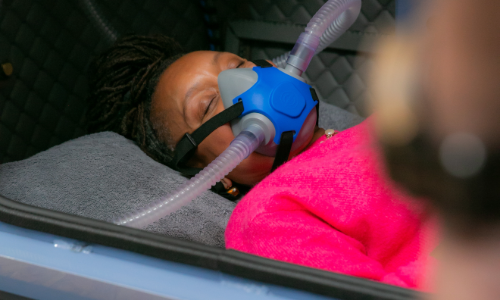
Sleep is often one of the first things to suffer.
For many people, sleep is where stress starts to become really noticeable. You struggle to switch off, wake during the night, or sleep for a reasonable number of hours but still wake up feeling as though your body has not really rested.
That relationship between stress and sleep is one of the reasons red light therapy has become such an interesting area of research.
A 2026 systematic review and meta-analysis brought together five randomised controlled trials involving 240 people and found that photobiomodulation was associated with improved sleep quality scores compared with sham treatment.
Researchers are studying how red and near-infrared light affect mitochondrial activity, cellular energy and neurological pathways involved in sleep and brain function.
At HybO2 House, we deliver red light therapy using a 360° full-body bed, with both read and near-infrared wavelengths. We would ever suggest that one session is going to undo a stressful week, but we do see clients using it regularly because it gives them a short, defined period where nothing else is being asked of them.
Ten or fifteen minutes in the bed may not sound like much, but for someone whose entire day is spent doing things for other people, it can feel very different.
Stress recovery and HBOT: where does it fit?
Hyperbaric oxygen therapy works in a completely different way.
Inside our hard-shell chambers, we increase the pressure to 2.0 ATA, twice normal atmospheric pressure, while near-pure oxygen is breathed through our BIBS.
That combination of pressure and oxygen changes the oxygen environment within the body, which is why researchers have studied hyperbaric oxygen therapy across areas including tissue repair, inflammatory processes, neurological recovery and cognitive function.
More recently, researchers have also been looking at mental and neurological wellbeing. A 2026 systematic review and meta-analysis included 17 studies involving 920 adults, with researchers reporting promising findings across depression, anxiety and PTSD symptoms.
One interesting detail for us was that the strongest pooled result for depressive symptoms was reported at 2.0 ATA, the same pressure used in our chambers.
HBOT is not a treatment for everyday stress, and we would not position it that way. But the research helps explain why oxygen under pressure is increasingly part of wider conversations around brain function, recovery and resilience.
How clients actually use HBOT for recovery.
This is where the real-life side of it becomes more interesting.
Not every client who comes to HybO2 House is recovering from an injury, surgery or illness. Some simply know that they feel better when they have a regular space in their routine that is dedicated to recovery, and for some, hyperbaric oxygen therapy becomes part of that routine.
They may begin with a specific goal and complete an initial course of HBOT, but once that course is finished, many tell us they do not want to stop completely.
And that is exactly why the O2 Club has become so popular.
After completing an initial course of 10 sessions, clients can continue with either two or four 60-minute HBOT sessions each month. For some, that means a session every other week. For others, it becomes part of their weekly routine.
What they often like is the consistency. Instead of waiting until they feel exhausted or depleted, they already have recovery built into the diary.
For busy people, that matters.
There is something quite powerful about having one hour where you are not answering emails, not running around, not making decisions and not being needed by anyone else.
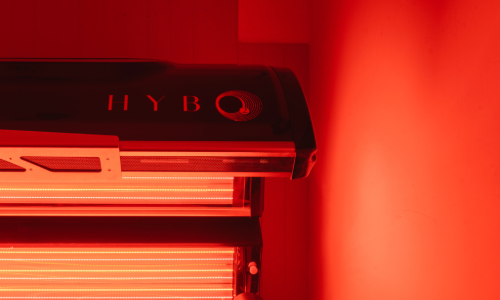
Red light therapy often fits into the same routine.
We see the same with red light therapy (RLT).
Some clients combine it with HBOT, while others use RLT on its own. Because the sessions are short, it can be much easier to fit into a working week, which makes it appealing for people who know they need to prioritise recovery but do not have huge amounts of free time.
The research around red light therapy is also continuing to broaden, with interest in sleep, muscle recovery, pain, inflammation, mitochondrial function and neurological health.
Again, the point is not that one session “fixes” stress.
The more useful way to think about it is that recovery works better when it becomes something you do regularly, rather than something you only think about once you are completely worn out.
If you are reading this thinking “that sounds like me.”
You may not feel like you are at breaking point.
You may still be managing everything perfectly well.
But perhaps you cannot remember the last time you properly switched off. Mybe your shoulders are permanently tense, your sleep is poor, your energy is unpredictable and you keep telling yourself that you will slow down when things get quieter.
The problem is that life rarely gets quieter by itself.
That is why we encourage clients to think about recovery before their body forces the issue.
It does not have to be dramatic. It does not have to mean completely changing your life.
Sometime it simply means creating regular space where your body is not being asked to keep up.
For some people, that is walking, exercising, getting outside or sleeping better. For others, HBOT or red light therapy becomes part of that wider routine.
Where to start:
If you are new to HybO2 House, Winchester, our Signature Experience is the easiest way to experience both therapies.
It includes a full consultation, 10 minutes of 360° red light therapy and 45 minutes of HBOT for £85, giving you the opportunity to understand how the therapies work and how they may fit into your own routine.
And for clients who complete an initial HBOT course and want to keep chamber time as a regular part of their week or month, the O2 Club offers a simply way to continue with either two or four sessions a month, from just £130.
Recovery does not have to mean stepping away from your life.
Sometimes it simply means making sure there is a small part of it that is not constantly asking something from you.