It happens every year.
The clocks change, the mornings get darker, daylight seems to disappear before the working day has even finished and suddenly everyone is talking about Vitamin D again.
There is a good reason for that.
Between October and early March in the UK, sunlight is not strong enough for most of us to make enough Vitamin D through our skin. The NHS therefore recommends that adults consider taking a daily Vitamin D supplement during autumn and winter.
But supplementation and Vitamin D deficiency are not quite the same conversation.
If you have actually become deficient, the first step is understanding your level rather than simply guessing.
And for the rest of this year, we’re making that incredibly easy here at HybO2 House: Vitamin D testing and a consultation with Bernie for just £5.
Why does Vitamin D matter?
Vitamin D helps regulate the amount of calcium and phosphate in the body, both of which are important for healthy bones, teeth and muscles.
When levels become very low, deficiency can contribute to muscle weakness, bone discomfort and, in more severe or prolonged cases, problems such as osteomalacia.
The difficulty is that Vitamin D deficiency is not always obvious.
Some people have very few symptoms. Others describe feeling tired, achy or generally not quite themselves.
And of course, all of those symptoms can have many other causes too.
That is exactly why testing can be useful when there is a genuine reason to suspect deficiency.

What can Vitamin D deficiency feel like?
Some of the more recognized signs include muscle aches, muscle weakness and persistent bone discomfort.
For some people, that weakness becomes noticeable in everyday movements, climbing stairs, getting up from a low chair or simply feeling as though their muscles are not performing as they normally would.
Fatigue and low energy can also be associated with Vitamin D deficiency, although tiredness is particularly non-specific and can be linked to everything from poor sleep and stress to anemia, thyroid problems and other health conditions.
So rather than looking at a symptom on Instagram and deciding “I must be deficient”, we would always rather start with information.
Why are we more interested in Vitamin D now?
Because November in the UK is very different from July.
During spring and summer, sunlight on the skin helps the body produce more Vitamin D. But once we reach autumn and winter, the sun sits too low in the sky for that process to provide enough for most people.
Diet can contribute some Vitamin D, particularly through foods such as oily fish, egg yolks and fortified foods, but getting enough from food alone can be difficult.
Some people are also at greater risk of deficiency throughout the year, particularly those who spend very little time outside, cover most of their skin outdoors or have darker skin.
Why test rather than guess?
More is not always better when it comes to vitamins.
Vitamin D is fat-soluble, which means excessive amounts can build up in the body. Taking very high doses unnecessarily can lead to raised calcium levels and cause problems including kidney and heart damage.
So when we are talking about high-dose Vitamin D, we want to know what we are dealing with first.
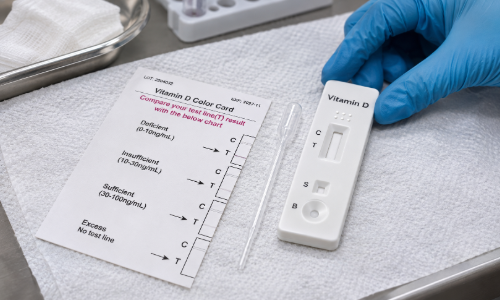
Our £5 offer includes your Vitamin D test and a consultation with Bernie, our registered nurse.
She can talk you through your result, your health history and whether any further action is appropriate.
What happens if my test shows I'm deficient?
If your result shows Vitamin D deficiency, you can book our Vitamin D course for £100.
The course includes two Vitamin D injections across six months.
High-dose Vitamin D is very different from taking an everyday supplement, which is why assessment matters first. Your result, medical history, medication and any relevant risk factors all need to form part of that conversation.
Could I just take a supplement instead?
For many people, an everyday Vitamin D supplement is exactly what UK guidance recommends.
But there is a difference between preventing low Vitamin D and treating a confirmed deficiency.
If you have symptoms, significant risk factors or concerns that your level may already be low, testing gives you more information to work with.
And that really is the point of this offer.
Not to tell everyone that they need an injection.
Not to assume every tired person is Vitamin D deficient.
Just to make finding out your level exceptionally easy.
Vitamin D Test & Consultation for just £5
If you’ve wondered about your Vitamin D levels, this is a very simple place to start.
For £5, you’ll receive your Vitamin D test and consultation with Bernie at HybO2 House.
If your result indicates deficiency, Bernie can talk you through the options available and whether our £100 two-injection Vitamin D course is appropriate for you.
And if you do book the course, you’ll also receive £5 off your next red light therapy session.
Because sometimes feeling better starts with knowing what your body actually needs.